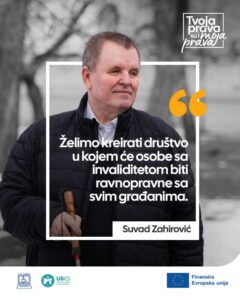
 I am a blind man, and for me, every day is White Cane Day. While my friends, acquaintances, and fellow citizens might remember this symbol once a year, I carry it with me every single day—out among people, on my way to work, or heading toward someone I wish to embrace. To me, it is a tool for independence, yet I often feel that the moment others see it, they stop noticing the man holding it. On my journeys through the city, I mostly end up "kissing" trucks and utility poles on the sidewalks—though I would much rather be kissing women.
I know some might laugh at that sentence—and I laugh too, because a bit of humor comes in handy when reality turns too harsh. Yet, when a truck parked across the sidewalk forces me to step out into the street, someone else’s “just five minutes” becomes, for me, a question of whether I will reach my destination safely. That same driver might share a post today in support of blind people, but it would mean far more to me if, tomorrow, they simply left the path clear.
My name is Suvad Zahirović. I am university-educated, and many consider me a successful man. I, too, am satisfied with my life—with what I have achieved and what I still wish to accomplish. Yet, I know the toll this life of constant effort takes on me, and how much easier—and different—things could be. Behind what others perceive as success lies an effort that goes unnoticed: paving a path for someone else to follow with ease, finding ways to access information that is readily available to others, and constantly explaining that I am capable of making my own decisions.
I do not say this to portray my life as some sort of heroic feat. In fact, I find the expectation that a blind person must be either miserable or extraordinary to be exhausting. Between pity and admiration, there seems to be little room for those of us who simply want to live an ordinary, fulfilling life. When I pick up my white cane, I do not become less capable or particularly brave; I am simply setting out to do what I intended. I would like people to ask how I am without focusing solely on my eyes, to speak to me even when a sighted person is standing beside me, and to take my "I can do it myself" just as seriously as my "I need support." I want to be invited to social gatherings rather than having others decide in advance that attending would be too difficult for me. When family and friends trust my decisions, their support gives me the space to live, learn, and take responsibility for myself. Sometimes, I too would like to be late because I overslept—rather than because the bus doesn't announce the stops—or to be tired from work itself, rather than from having to prove that I am capable of working.
Blind people want to earn a living, choose where to live, fall in love, and start families. We want to be attractive to someone, to have arguments and make up with others—without blindness becoming the explanation for everything that happens in our lives. When I think about all that makes life rich, I also think of the interests we share with other people. Among us, there are fans of sports and music, culture and art; there are amateur radio enthusiasts and those who enjoy handicrafts. Some love to travel, visit museums and historical sites, discover natural beauty, or go hiking.
We aren't all drawn to the same things—just as sighted people aren't. I wish that, instead of being asked what blind people can actually do, we were more often asked what interests us and what kind of support we need to enjoy those things. An accessible museum or hiking trail, a good description of a work of art, and support while traveling open the door to new experiences, connections, and a sense of joy that no one should assume is out of our reach. When people tell me I just need to be persistent, I think of a 100-meter race where my starting line is set a full hundred meters behind everyone else's. I can run the race and feel satisfied that I finished, but while I’m being congratulated on my persistence, I want someone to ask why I had to cover twice the distance in the first place.
My success does not mean that the obstacles are acceptable, just as the man who did not manage to overcome them is not less valuable because of that. Support is part of my independent life. Sometimes I need someone's hand, sometimes technology or information in a form I can read. I want to get it when I need it and keep the right to decide where I go and how I live. It's hard to talk about freedom if every form of support comes with an expectation to be obedient or endlessly grateful.
And if there were fewer obstacles, the community would also get more from us. The time and energy we spend on finding detours could be invested more in work, family, friendships and everything we contribute to others. A free sidewalk makes it easier for a parent with a stroller, an elderly person, and someone recovering from an injury to move around. A clear announcement on the bus also benefits the passenger who is coming to the city for the first time. An environment in which I can live more freely becomes more comfortable and safer for many more people than it seems at first glance.
That is why, on White Cane Day, when you catch sight of me, I would like you to remember that I am on my way somewhere—and that, at the end of that journey, there is something that matters to me.
Perhaps a job I love awaits me, a friend with whom I want to have a coffee, or a woman I look forward to seeing.
My life continues even after this date has passed, with all the plans and pleasures that will lead me to pick up my walking stick again tomorrow and head out.
So, I will continue on my path; just leave me room to pass and acknowledge me when we meet. There is still so much I want to experience, and I would finally like to cut trucks out of my love life.
Suvad Zahirovic