
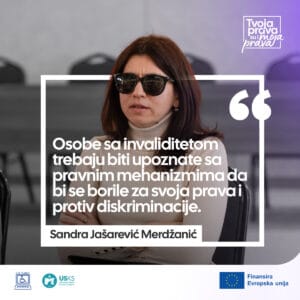
 As part of the campaign "YOUR RIGHTS ARE MY RIGHTS", realized by I.C. "Lotos" and the Association of Blind Persons of Sarajevo Canton with the aim of informing the public about the state of implementation of human rights and the position of persons with disabilities in Bosnia and Herzegovina, we spoke with Sandrom Jašarević Merdžanić, Master of Laws, long-time activist in the field of human rights, member of the leadership of the Network of Women with Disabilities in BiH and member of the Council for Persons with Disabilities in BiH. We talked with Sandra about the rights of people with disabilities, especially women with disabilities, about discrimination and the personal fight against discrimination, but also about the importance of knowing legal mechanisms in the fight to improve the position of people with disabilities. We started the conversation with a story about discrimination that people with disabilities face on a daily basis.
How often did you encounter discrimination and how did these experiences affect you personally?
I encountered discrimination in my daily life, especially when it came to education and employment, however, I successfully overcame obstacles by using various legal instruments, as well as arguments when talking to people who tried to discriminate against me.. Discrimination affected me in a way that made me even stronger. She awakened my consciousness and gave me the wind at my back to fight - not only for myself, but also for society as a whole.
Are there any situations that are particularly difficult for you?
The most difficult, in fact, are those forms of discrimination that are not immediately visible. It is this silent, indirect discrimination that people with disabilities often do not even notice, because it is often justified by "other reasons", and essentially leads to exclusion. I am particularly affected by the discrimination that happens to other people with disabilities. In these situations, I am present and notice what is happening, but I still cannot react because it concerns the person who is being discriminated against and where the person himself is called upon to react.
When we talk about women with disabilities, what are the most prominent problems?
Discrimination against women with disabilities is particularly pronounced in the field of health care. For example, the lack of adapted gynecological tables and mammograms for wheelchair users leads to serious inaccessibility of health services. It happens that certain instruments formally exist, but unfortunately they are not adapted to the real needs of women with disabilities.
Are the rights of people with disabilities equal for everyone?
Unfortunately, no. There are situations in which certain rights are enjoyed exclusively by war disabled soldiers, and not by all persons with disabilities. For example, in some local communities there used to be subsidies for kindergartens that were only available to disabled war veterans. In the meantime, these subsidies have been abolished, so today they cannot be used by women with disabilities, that is, mothers, for whom such support would be natural and extremely significant.
How much did legal education help you in your personal struggle?
The fact that I am a lawyer and that I got to know my own rights through my education certainly helped me. However, this does not mean that other disabled people cannot do the same. This is precisely why I am calling on people with disabilities to educate themselves, to collect information, because this will further empower them to fight for their rights and to oppose discrimination - both for themselves and for the sake of others. When we know our rights well and when we clearly point out discrimination, then even those who would potentially discriminate against us refrain from such actions, because they know that they will be sanctioned.
To what extent is ignorance of the environment a factor in discrimination?
People with disabilities are often underestimated in society and characterized as "poor" or less capable. That is why people are surprised when they meet functional, highly educated people with disabilities who are extremely productive and valuable members of society. These prejudices often lead to discrimination in education and employment, where people with disabilities are placed in an unequal position.
People in the environment often do not have enough experience in contact with people with disabilities. This inexperience sometimes results in comments and actions that can be offensive or discriminatory, but are not necessarily intentional.
What is your advice to others who find themselves in such situations?
It is important that we, people with disabilities, do not always experience such clumsy comments personally, but to openly talk and educate others, but also to learn to distinguish clumsiness from real discrimination. That is why it is important for people with disabilities to be educated about legal mechanisms, to collect relevant information and to know how to recognize discrimination, as this will further empower them to fight for their rights and to oppose discrimination.
The interview with Sandra Jašarević Merdžanić was carried out as part of the campaign "YOUR RIGHTS ARE MY RIGHTS" which I.C. "LOTOS" Tuzla and the Association of Blind Cantons of Sarajevo with the support of the European Union, is implemented as part of the project "Creating policies in Bosnia and Herzegovina with respect for human rights and the rights of persons with disabilities", which aims to improve public policies in the field of disability in Bosnia and Herzegovina through the promotion of an approach based on human rights.