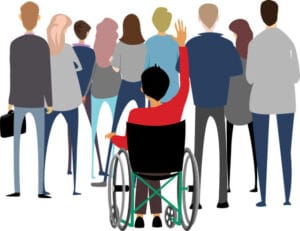
Discrimination is not an abstract legal concept. It has a name, a face and consequences. For young people and women with disabilities in Bosnia and Herzegovina, discrimination means missed opportunities, constant proof of one's worth and a system that is not designed for all citizens equally.
Campaign Your rights are my rights too. it starts from a simple truth: the rights of people with disabilities are not special rights – they are the same rights that belong to everyone. When they are violated, society as a whole becomes weaker.
According to the UN Convention on the Rights of Persons with Disabilities, discrimination means any distinction, exclusion or restriction on the basis of disability that has the aim or result of reducing or preventing the enjoyment of human rights on an equal basis with others. It also includes denial of reasonable accommodation. This means that discrimination does not have to be an outright prohibition. It is enough that the system does not remove the barriers that prevent equal participation.
A young man with cerebral palsy describes his high school days: I sat in the back row because they said it was easier that way. I had no assistant. When there were group exercises, no one picked me because I was slower at writing. Formally, the right to inclusive education exists. In practice, the lack of assistants, unsuitable materials, and inaccessible buildings mean that young people with disabilities finish school without full participation and without equal opportunities. The result? Weaker competitiveness on the labor market and long-term economic insecurity.
A law graduate in a wheelchair says: At the job interview, they told me that they don't have a ramp and that the adaptation would be complicated. They said they would call me. They never did. According to the available data, women with disabilities make up a significantly smaller percentage of employed persons with disabilities, even compared to men with disabilities. Discrimination in the labor market has a double effect: the individual loses income and professional development, and the state loses tax revenues and productivity. When young people with disabilities stay out of the labor market, social protection costs rise and potential remains untapped.
A woman with hearing loss describes a gynecological examination: I didn't have an interpreter. The doctor spoke quickly. I felt embarrassed because I kept having to ask him to repeat himself. The lack of adapted medical equipment and communication accommodations particularly affects women with disabilities. It's not just a matter of comfort – it's a matter of dignity and safety.
Persons deprived of legal capacity may lose the right to vote, marry or decide on their own life. A young woman says: I am 28 years old, but someone else signs the documents for me. Such practices further marginalize young people and women with disabilities and send the message that their will is not equally valuable.
Discrimination has a measurable cost. Unemployment of people with disabilities means lower GDP, lower tax revenues and higher allocations for social transfers. Investing in accessibility, inclusive education and employment is not an expense – it is a development strategy. Evidence-based policies in the field of disability imply budget planning that takes into account the long-term economic benefits of inclusion.
As Sandra Jašarević Merdžanić points out, equality is not an act of grace, but an obligation. Violation of the rights of young people and women with disabilities is not only an individual injustice - it is a social failure. A society that removes barriers becomes stronger, more productive and fairer.
Because your rights are also my rights.