• M. and Z. Crnogorčevića no. 3, 75000 Tuzla
  • +387 35 251-476; 251-245
  • info@ic-lotos.org.ba
  • Ona.ba
Facebook Youtube Instagram
Logo IC Lotos Tuzla

Citizens' Association Information Center for
persons with disabilities "LOTOS" Tuzla

  • Home
  • About us
    • Mission
    • Vision
    • Goals
    • History
    • Board of Directors
    • Our team
    • Our members
  • Download
    • Statute
    • Annual reports
    • Codes
    • Strategy
    • Publications
    • Research
    • Legislation
    • Latest for download
    • Initiative Magazine
    • Measures for accessible BiH
    • Rights of people with disabilities
  • Programs
    • Young people
    • Women
    • Regional cooperation
    • Projects
    • Kampanje
  • News
  • Join us
  • Donors
  • Contact
  • en_USEnglish
  • bs_BABosanski
  • |
  • Monday - Friday: 08:30 - 15:30
  • Account number: NLB Bank 1321000309103215
  • Home
  • About us
    • Mission
    • Vision
    • Goals
    • History
    • Board of Directors
    • Our team
    • Our members
  • Download
    • Statute
    • Annual reports
    • Codes
    • Strategy
    • Publications
    • Research
    • Legislation
    • Latest for download
    • Initiative Magazine
    • Measures for accessible BiH
    • Rights of people with disabilities
  • Programs
    • Young people
    • Women
    • Regional cooperation
    • Projects
    • Kampanje
  • News
  • Join us
  • Donors
  • Contact
  • en_USEnglish
  • bs_BABosanski
  • |

Recipients of the “Martin Naughton” Memorial Scholarship for Young People: An Interview with Ervin Ćosić

By Jasminko Bijelić  Published On 23/11/2026
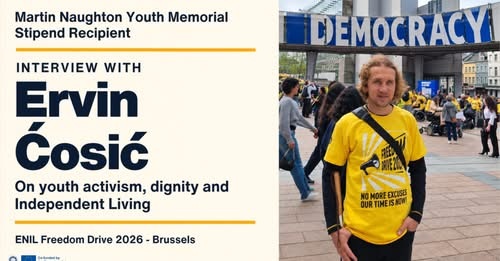
Text: "Winner of the 'Martin Naughton' memorial scholarship for young people. Interview with Ervin Ćosić. About youth activism, dignity and independent life. ENIL Freedom Drive 2026 - Brussels."
Ervin is one of two young people who received the "Martin Naughton" memorial youth scholarship for participation in the 2026 ENIL Freedom Drive in Brussels. After the event, the Board of Directors of the ENIL Youth Network wanted to find out what this experience meant to him, discuss his advocacy and give you the opportunity to meet him. Ervin shared valuable insights and thoughts about youth activism in Europe and how we respond to contemporary challenges. Read what he shared with us!
What motivated you to apply for the "Martin Naughton" memorial scholarship for young people?
The main motivation for my application was a strong desire to network with organizations and activists from the European Union and other countries. I believe that the exchange of experiences and good practices is key to strengthening the movement for independent living, and this scholarship provides a unique opportunity to learn and acquire new knowledge that I can directly apply in my work with young activists in my country. In addition, this scholarship has a deeply personal dimension for me. As someone who lives an independent life every day, I am motivated to continue the fight for the advocacy and promotion of the philosophy of independent living, in order to create better conditions and equal opportunities for all young people with disabilities.
What does independent living mean to you personally — beyond its formal definition?
For me, independent living goes beyond a mere formal definition or physical independence; it represents the freedom to make decisions and a way of living without unnecessary restrictions and restraints. This means having equal opportunities and opportunities for learning, I freely make my own mistakes and take responsibility for them myself, because it is an integral part of growing up and personal development.
For me, independent living brings dignity and respect within the community in which I live, allowing me to be politically active and involved in relevant social events. The point is to be an active member of society in my local community — someone who contributes to positive changes through my work, and not just a passive recipient of aid.
Was there a specific moment or experience that made you realize you wanted to get involved in activism for the rights of persons with disabilities?
The key turning point happened when I lost my sight at the age of 21, at a critical stage when a young man needs to get a serious education and build a career. Although I did not lose my desire to continue my education and progress, on that path I encountered serious resistance in the social community. Problems with inaccessible literature, as well as complete architectural and information inaccessibility, created additional obstacles. However, instead of discouraging me, these injustices ignited in me the desire to resist an inert system. I started advocating for a better position in society and fighting for the rights of those who may not be strong enough to raise their voice at that moment. I believe that activism is not just a role, but a lifestyle that all young people should live, so that we can fight together for a fairer position and a more dignified life for each individual.
What is one thing you wish you had known when you first started advocating for the rights of persons with disabilities?
I wish I had known from the very beginning that this struggle is not a solo endeavor, and that this marathon can only be successfully completed as a team. To achieve real results, it is essential to know how to take action and focus one’s efforts on the key segments of the system. Today, drawing on the valuable experience I have gained, I find myself surrounded by brilliant people with whom I work and collaborate; I now realize how much easier, more meaningful, and more powerful it is when we fight together to secure our rights.
What is the biggest obstacle that young people with disabilities face when they want to become activists or leaders?
Beyond the deeply rooted prejudices that still persist in society, the greatest obstacle is that young people with disabilities often lack opportunities where they are genuinely trusted to take on significant roles. Furthermore, an inadequate educational system, a lack of accessible information, and the absence of personal assistance services are key factors that hinder the process of achieving independence. Without these fundamental conditions, it is significantly more difficult for young people to develop the skills, self-confidence, and leadership potential necessary to drive real change.
Do you think that young people with disabilities are truly listened to in spaces where decisions are made, or are they sometimes invited only to "fulfill the formality of inclusion"?
I believe that young people with disabilities are most often invited to events, guest appearances and hearings only to formally justify inclusion. Unfortunately, we often serve as a cover for certain structures, such as political parties during election campaigns, where people with disabilities are used to attract public attention, fulfill quotas or create the appearance of numbers. So that everything is not completely black, there are also bright examples in which young people with disabilities managed to win the space to be truly heard and respected. However, these are still the exception, not the rule. It is a long and thorny path that a movement has to go through in order to reach the level of equality and a position where its voice is really taken into account when making decisions.
What is one stereotype about young people with disabilities that you would most like to challenge?
I wish there were only one, as that would mean we had addressed the root of the problem; unfortunately, however, a great many prejudices still persist in society. Nevertheless, if I had to single one out, it would be the stereotype regarding passivity and dependency. The notion that young people with disabilities are entirely dependent on the help of others—that they are passive and helpless—has gone far beyond acceptable limits. Young people with disabilities are more than capable of working, creating, and making significant contributions to society; they simply need what belongs to everyone: fair and equal opportunity, as well as the motivation to demonstrate their full potential.
How do you balance activism with your private life, studies, work, or simply with the time spent just being a young person?
I admit that sometimes it can be too overwhelming and that the schedule is often hectic due to the large number of projects and side activities. In addition to work duties, I try to maintain the household completely independently: tidying the apartment, cleaning, washing clothes and cooking meals - all of which require time and drain energy. However, despite everything, I always find a way to recharge my batteries with new energy by using the power of nature and spending relaxing moments in company. The key is that when you're doing what you love and what you firmly believe in, it's easier to find strength and energy, and balance is established through the small, beautiful moments that make life fulfilling.
Where is the line between activism and work? Should the activism of people with disabilities always be paid, and how does money change the way we think about activism?
The limit lies in moving from pure passion and inner feeling for justice and professional obligations. Activism really starts as volunteerism, but when it grows into managing complex projects, writing analyses, legal advocacy and day-to-day work, it naturally becomes a professional job that requires time, skills and energy, and in that case should be paid due to personal motivation. Likewise, I believe that activism should not be based exclusively on volunteerism and unpaid work. Inadequate evaluation of effort leads to activist burnout and instability. On the other hand, when work is adequately paid, it provides activists with financial stability and additional motivation for long-term, dedicated and quality work to achieve the movement's goals.
If you could change one thing in your country tomorrow to improve the lives of young people with disabilities, what would it be?
If I could change only one thing, it would without a doubt be the establishment of systemic support for independent living, with special emphasis on legal and stable financing of personal assistance services. Without this, young people with disabilities are often completely dependent on their families or obstacles in the environment, without a real opportunity to make their own decisions. By ensuring stable personal assistance, we would enable full autonomy, freedom of movement and the opportunity for young people to live with dignity as equal members of society.
What would you like to achieve with the opportunities, contacts or experience provided by the "Martin Naughton" Memorial Youth Scholarship?
Through this scholarship, I would like to achieve the application of successful European practices and models in advocacy for personal assistance in our country. Also, it is extremely important for me to use the network of acquaintances and contacts with European organizations to exchange experiences and open new doors for cooperation. I plan to direct the acquired knowledge to the provision of mentoring and the transfer of skills to young people in local communities, in order to build a wider, stronger and louder network of future leaders.
If activism by people with disabilities were to disappear tomorrow—because we had achieved everything we are fighting for—what would you want to do instead with all that time and energy?
Although it is a big question, I believe I would continue to spend my time creating and building something socially beneficial—something healthy for both myself and my surroundings. I would direct all my energy toward quality of life, spending significantly more time in nature, and dedicating myself to cultivating and tending to my garden and flower beds. Furthermore, I would embrace a quieter life, spending time with people dear to me—friends and family—enjoying quality, unburdened moments free from constant phone calls and the pressure of deadlines. In addition, I would use this time for continuous education and personal development, learning new skills and engaging in activities for which I currently simply lack the time due to an overly packed schedule.


Logo IC Lotos Tuzla

Udruženje građana Informativni centar za osobe sa invaliditetom "LOTOS" Tuzla

The Information Center "Lotos" brings together people with or without disabilities who are interested in contributing to the achievement of the organization's mission through their work, either on a professional or volunteer basis. 

Facebook Youtube Instagram

Contact information

  • M. and Z. Crnogorčevića no. 3, 75000 Tuzla
  • +387 35 251-476
  • +387 35 251-245
  • info@ic-lotos.org.ba
  • ic.lotos@bih.net.ba
©2026. Informativni centar za osobe sa invaliditetom "Lotos" Tuzla. Sva prava pridržana. Sav sadržaj na ovoj web stranici zaštićen je autorskim pravima. Developed by Futura Multimedia doo Tuzla
imunify-bot-check
Upravljajte saglasnostima
Da bismo pružili najbolje iskustvo, koristimo tehnologije poput kolačića za čuvanje i/ili pristup informacijama o uređaju. Saglasnost sa ovim tehnologijama će nam omogućiti da obrađujemo podatke kao što su ponašanje pri pregledanju ili jedinstveni ID-ovi na ovoj veb lokaciji. Nepristanak ili povlačenje saglasnosti može negativno uticati na određene karakteristike i funkcije.
Funkcionalno Always active
Tehničko skladištenje ili pristup je striktno neophodan za legitimnu svrhu omogućavanja korišćenja određene usluge koju izričito zahteva pretplatnik ili korisnik, ili u jedinu svrhu obavljanja prenosa komunikacije preko elektronske komunikacione mreže.
Preference
Tehničko skladištenje ili pristup su neophodni za legitimnu svrhu čuvanja preferencija koje ne zahteva pretplatnik ili korisnik.
Statistika
Tehničko skladište ili pristup koji se koristi isključivo u statističke svrhe. Tehničko skladište ili pristup koji se koristi isključivo u anonimne statističke svrhe. Bez sudskog poziva, dobrovoljne saglasnosti od strane vašeg Internet provajdera ili dodatne evidencije treće strane, informacije sačuvane ili preuzete samo za ovu svrhu obično se ne mogu koristiti za vašu identifikaciju.
Marketing
Tehničko skladište ili pristup su potrebni za kreiranje korisničkih profila za slanje reklama ili za praćenje korisnika na veb lokaciji ili na nekoliko veb lokacija u slične marketinške svrhe.

  • Manage options
  • Manage services
  • Manage {vendor_count} vendors
  • Read more about these purposes
Prikaži podešavanja
  • {title}
  • {title}
  • {title}